Skip to content

SMB Growth#

You Don't Need an AI Hire. You Need an AI Champion.

You don't need an AI hire. You need an AI Champion. The advantage isn't AI alone. It's domain expertise + AI.

The instinct makes sense. Hire someone younger who gets AI. Have them sit next to the person who knows the work. Let them figure it out.

It won't work. Here's why.

A business owner in a session I co-hosted came in with a plan.

He runs a service business. Sharp guy. His construction accountant is good at her job. He doesn't understand her work and doesn't need to. His plan: hire a college student at a thousand dollars a week, have them sit next to her, figure out how AI could make her more efficient. He'd already done the ROI math in his head.

He had the right idea. He saw the bottleneck, he did the ROI math, he was ready to move. He was just wrong about who should do the work.

The Correction Came From Someone Else in the Room

Another business owner cut in -- not me, not my co-host. A peer.

"It'll give you an advantage. But hiring a kid -- you won't know what to tell them to work on. You know what your business needs better than anybody."

That's the line that matters. Not because it's surprising, but because of who said it.

Not a consultant. Not someone with a service to sell. Someone in the same seat.

Here's the trap he saw: if you hire someone who doesn't know the work to implement the tech, you're just adding another layer of management. You're now managing a kid who's trying to manage a process he doesn't understand. That's $4,000 a month -- $1,000 a week, four weeks -- before you've changed a single process.

The Matrix Problem

My co-host put it this way: when you're a subject matter expert watching AI work through your domain -- accounting, legal, operations, doesn't matter -- you immediately know when something is wrong. You can feel it before you can name it.

Someone else watching the same screen? It's a wall of scrolling text. Impressive-looking. Meaningless to them.

The kid can learn to use the tools. He cannot catch the mistake in work he doesn't understand.

Your construction accountant has been doing this for years. She knows when the number doesn't look right. She knows which edge cases matter and which don't. She knows which reports take six hours that should take six minutes.

She needs to be the one watching the screen. Not as a spectator. As the person whose judgment the whole system depends on.

That's not a junior hire. That's someone you already have.

What an AI Champion Actually Is

Here's what I keep seeing every time this works.

The company finds the person who knows a specific workflow cold. Not the most tech-savvy person on the team. Often not even close. The person who knows the work best.

They give that person time and permission to experiment. They pair them with someone who can build what that person can judge. And then they protect the feedback loop -- the champion's ability to say "that's wrong" is the whole system.

McKinsey put a name to it -- "AI translators." Their 2025 State of AI report found that high-performing organizations are 3x more likely to have one actively championing AI. Different label. Same model.

Another founder -- he runs a plumbing company -- was already doing this. He wasn't hiring anyone. He was enlisting his existing SME. His framing: "You gotta break the seal. Once you break the seal, it changes."

That's it. One person. One workflow. An outside partner who can build what that person can judge. Neither half works without the other.

The outside partner can't do this alone -- they don't know which output is wrong. The inside champion can't do it alone -- they don't have the build skills to harden what works.

The Gap Most Businesses Are Stuck In

The gap has a number. Goldman Sachs put it on paper last March -- 10,000 small business owners. 93% of AI-using businesses say it's had a positive impact. Only 14% have fully integrated it into core operations. (Goldman Sachs 10,000 Small Businesses, March 2026)

79 points between "it helps" and "it's embedded in how we run."

That gap has a name. It's the absent Champion.

The business tried something. It worked. Nobody owns it. Nobody teaches the team. Nobody builds the next thing on top of it. Six months later they have four AI "projects" and no AI muscle.

The Champion is the missing piece. Not because they're technical. Because they know the work well enough to say what good looks like.

He Got There

At the end of the session -- two-plus hours in, same room, same people -- the same exec came back to it.

"If I hire this kid, can I hire you to teach him? Help him be my champion?"

He got there. Not through persuasion. Through the conversation. Watching other owners work through it.

The model is that simple once you've seen it working.

The Question to Answer Before You Post a Job

Who in your company already knows the workflow you most need to fix?

Not "who's excited about AI." Not "who's most technical." Who knows the work so well that they'd catch a mistake in three seconds that would take anyone else an hour to find?

That's your starting point. One person. One workflow. If you missed the earlier post on why your domain expertise is worth more than any AI prompt, this is the practical application of that idea.

If you need the outside-partner half of that equation -- someone who can build what your Champion can judge -- that's exactly what we do at JOV AI.

Let's talk.


This is the fourth post in a series about what I learned co-hosting a 140-minute AI session with a group of business owners.

Why Your Domain Expertise Is More Valuable Than Your AI Prompt

Why Your Domain Expertise Is More Valuable Than Your AI Prompt

Most business owners are quietly paying for software that almost fits their business.

A platform that locks them in. A vendor that ships features they didn't ask for. A line item that climbs every renewal whether the team uses it or not.

Last month, an owner in a room I was in mentioned, almost as an aside, that he'd built his own property management operating system with AI. In seven days. The kind of thing his industry rents from vendors for around $200,000 a year.

The room went quiet.

Here's the shift: it's not about software getting cheaper. It's about your unfair advantage finally becoming buildable.

You could feel everyone recalibrate.

Ben already wrote the software-side argument from this same session: the cost of software is moving toward zero. He's right.

But the lesson isn't "I should build all my own software now."

The real lesson is simpler.

AI makes domain expertise executable.


The Build Was Impressive. The Builder Mattered More.

Everyone asks one question: "What tool did he use?"

The answer is the trap.

You'll copy the tool. You won't copy the understanding.

The build worked because he knew the business. He knew which fields mattered and which ones only existed because a vendor needed them. He knew which reports helped people make decisions. He knew the weird exceptions that break clean workflows. He knew the handoffs that quietly fail near renewal time.

That's the part a generic software product never has on day one.

It's also the part a junior "AI hire" doesn't have. A smart kid can learn the tools. They can't walk in and know why a dashboard is lying, which tasks create risk, or why the same customer record shows up three different ways.

The AI didn't replace business knowledge.

It finally gave business knowledge a build surface.


The Prompt Is the Visible Part. The Judgment Is the Asset.

Most companies get this backwards. They look at a story like the seven-day build and decide they need to find the person who can prompt the best.

That's the wrong hire.

If you ask AI to build a workflow and you can't explain how the workflow should actually work, you get noise. Maybe polished noise. Maybe useful-looking noise. But still noise.

The model isn't the bottleneck. The clarity is.

The owner in that room didn't succeed because he had a magic prompt. He succeeded because he could look at an AI-built version of his business and say:

This field is wrong.

This report is missing the decision.

This handoff will fail at renewal.

This is how my team actually works.

This step needs to happen before the manager ever sees it.

That's not technical knowledge. That's operator knowledge. And right now, operator knowledge is wildly underpriced.


Why This Shift Happens Now

Three years ago, this story would have started with a developer. Scoping took weeks. The first useful version cost real money before anyone knew whether the workflow was right.

Today, the operator can build the rough first version himself. Then someone with software judgment hardens what works: permissions, data quality, security, reliability, and edge cases.

That changes the economics. The first question is no longer, "Can we afford custom software?" It is, "Can we prove this workflow is worth owning?"

That is where JOV fits. We are not trying to replace operator judgment with tools. We are trying to turn operator judgment into working systems.


Your Unfair Advantage Is the Stuff Vendors Never Learn

Every business has an operating layer vendors never learn: the Friday spreadsheet, the client report stitched together from three systems, the intake exception, the renewal workflow carried by a veteran employee.

That stuff is invisible. It's also where AI gets real.

Not "write me a strategy." Build the thing that removes drag from the business you already understand.

That's why the seven-day build matters. Not because every owner should spend the weekend replacing their software stack. Most shouldn't. Security, permissions, data quality, and production reliability still matter.

It matters because it proves the bottleneck moved. The bottleneck used to be whether you could afford software built around your business. Now it is whether you can describe the work clearly enough for AI to help build it.


What This Looks Like at SMB Scale

The seven-day build is the dramatic version. Here's the everyday one.

A multi-location wellness operator I work with runs the business on a vertical-specific accounting and booking platform that costs around $150,000 a year. The kind that keeps everything in a closed ecosystem because that's how they upcharge you. Every adjacent feature is a paid line item. The person handling operations isn't a developer, but he knows the business. Over the last several months, he has been using AI to build small apps that work around the closed platform. Each one replaces one paid upsell. He's stacking these.

Ben is helping turn the working ones into production-grade tools. That's the maturity arc: an operator builds the first version because he knows the business. Someone with software judgment hardens what works for security, reliability, and the edge cases. Neither half does it alone.

That's the model. It scales down to one retired line item at a time, and up to a $200K system in seven days.


Two Bad Reactions, One That Actually Works

We see two predictable reactions to this shift.

The first is DIY bravado. "Great, software is free. We'll build everything ourselves."

Result? A prototype becomes one person's private system. No permissions model. No audit trail. No one else trusts the data, so the old vendor stays live in parallel.

The second is vendor reflex. "Great, let's hire an AI person and have them figure it out."

Result? Someone learns the tools but never the business. They automate the obvious stuff and miss the expensive stuff: the exception, the handoff, the renewal risk, the report that actually drives a decision.

The version that works is a partnership.

One operator inside who can say what good looks like. One implementation partner outside who can turn that into AI workflows, software, automations, and guardrails.

Start with the workflow that already has a number attached to it: the tool you keep renewing reluctantly, the report that takes six hours, the handoff that creates rework, or the process your best employee carries in their head.

If you can't put a dollar, hour, risk, or revenue number on it, it can wait.


The Next Seven Days

Don't start by asking, "What app should we build?"

Start with three questions:

  1. What part of the business do we understand better than any vendor ever will?
  2. What recurring workflow is expensive because it's trapped in people, spreadsheets, or rented software?
  3. Who inside the business can judge whether the AI-built version is actually right?

That third question is the one most people skip.

Without that person, AI produces demos. With that person, AI produces operating leverage.

That's the shift. For SMB owners, it's the opportunity.

Start here: which of these is costing you the most?

  • [ ] A vendor subscription for features your team doesn't use
  • [ ] A manual report or process your best employee carries in their head
  • [ ] A workflow trapped between three systems with no clean handoff
  • [ ] A renewal price that climbs every year

Pick one. Then Let's Talk. We'll use it to scope the first useful build: the smallest workflow that can free capacity, retire spend, reduce risk, or unblock revenue.


Sources:

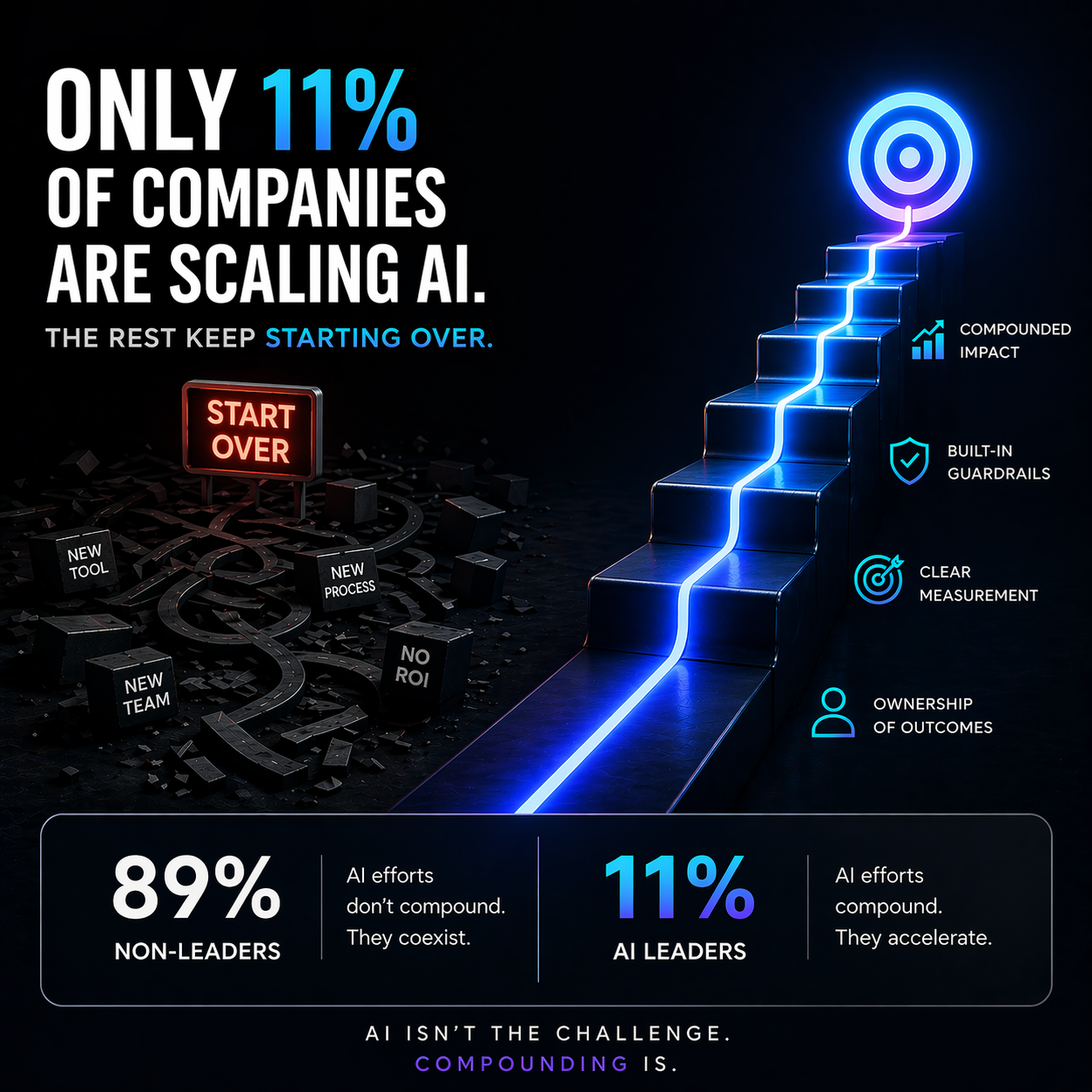
Only 11% of Companies Are Scaling AI. The Rest Keep Starting Over.

Only 11% of Companies Are Scaling AI

You automated a workflow. It worked. Maybe you saved six hours a week on reporting, or cut your meeting prep in half. Your team noticed. You felt the win.

Then you tried to do it again in another department and hit a wall.

That wall is where most businesses get stuck. Not at the start. After the start.

Here's the number I can't get past: only 11% of companies qualify as AI leaders in KPMG's Q1 2026 Global AI Pulse.

Not 11% using AI. Almost everyone is using AI.

Eleven percent getting coordinated results across the business.

The other 89% aren't failing. They're just not compounding.

And yes, KPMG's sample is larger companies. But I see the same pattern even faster in SMBs, where smaller teams have less room for vague ownership and broken handoffs.


The Word Nobody Wants to Hear

Here's the word most business owners don't want to hear: governance.

I know. You heard "governance" and thought: lawyers, compliance, red tape.

That's not what I mean.

McKinsey made the point clearly in March 2026. Governance isn't the thing that slows AI down. It's the thing that lets it expand.

Think about it practically. If nobody owns the output, if nobody defined what success looks like before rollout, and if there's no plan for when the system gets it wrong — you can't responsibly give AI more responsibility inside the business.

So it stays at the edges. Drafting a few emails. Summarizing a few notes. Maybe saving some time.

But it never changes the way the business actually runs.

That's not a governance failure. That's a governance vacuum. And it's the reason most companies stay stuck after their first win.


Why the Second Workflow Is Harder Than the First

Here's the pattern I keep seeing.

First workflow works great. Owner gets excited. Tries to roll out three more at once. Each one gets managed by a different person, with different tools, different standards, and a different definition of success.

Six months later you have four AI "projects" and no AI "system."

KPMG's Global Tech Report puts a number on the operational problem: 51% of tech executives say legacy processes are contributing to poor ROI on their tech investments. In smaller companies, Goldman Sachs found the same gap — 93% of small businesses using AI say it's had a positive impact, but only 14% have fully integrated it into core operations (Goldman Sachs 10KSB, March 2026).

That's not about old software. It's about old handoffs, unclear ownership, and workflows nobody fixed before layering AI on top.

The first win doesn't require a system. You just need one person, one problem, and one tool. But the second win? The third? Those require something the first one didn't: a repeatable model for how AI gets deployed, measured, and improved inside the business.

Without that model, every new workflow starts from scratch. And starting from scratch every time is how you stay in the 89%.


What the 11% Do Differently

When I look at what separates the companies getting coordinated results from the ones collecting standalone wins, three things show up every time.

1. One person owns AI outcomes, not AI tools.

Not a Chief AI Officer. Not whoever is most "tech-savvy." The person who owns the business outcome the workflow is supposed to improve. If AI is supposed to cut reporting time, the person who owns reporting owns the AI outcome too. Ownership follows the metric, not the technology.

2. Success is defined before rollout, not after.

The 11% don't launch AI and then check if it helped. They name the metric first. Time saved. Errors reduced. Revenue influenced. If you can't name the metric before you start, you're not ready to scale.

3. Guardrails are built into the workflow, not bolted on later.

What data can the tool touch? What requires human review? What happens when the output is wrong? The companies scaling AI answer these questions before the second workflow launches. Not after the first incident.

None of this is complicated. But it's the part almost everyone skips.


What Happens When This Clicks

When those three things are in place, something changes.

The second AI workflow deploys in days, not months. The third is faster still. Each one inherits the ownership model, the measurement framework, and the guardrails from the last.

That's what "AI leader" actually means in the KPMG data. Not more tools. Not bigger budgets. AI leaders report meaningful business value at 82%. Non-leaders: 62%. Same market. Same access to tools.

Different operating discipline.

The gap isn't about adoption anymore. It's about whether your AI efforts compound or just coexist.


This is the part most businesses skip. Not because they don't believe in it, but because nobody walks them through it while the work is happening.

That's how we operate. We start with the bottleneck. Find the quick win. But while we're building that first workflow, we're asking the questions that make the second one faster: who owns this, how do we measure it, and what are the guardrails?

We built this framework with a Dallas foundation from scratch - policy, data classification, ownership model. It's the same approach we bring to every engagement, because it's how AI stops being a project and starts being the way you run.

If you've had your first AI win and want the next five to stick, let's figure out how to pair these tools with the people who actually know your business. Let's Talk.


Sources:

AI Slop Is a Confession

AI Slop Is a Confession

You've seen it. The LinkedIn post that reads like a robot summarized a robot. The sales email that opens with "Dear [First Name]" and goes downhill from there. The blog post so generic it could be about any company in any sector on any planet.

"Slop" became Merriam-Webster's Word of the Year in 2025. The American Dialect Society picked it too. Everyone agrees the problem is real.

But here's the question nobody's asking: why does the slop exist?

The Amplifier, Not the Problem

I was in a room full of business owners recently when my CTO reframed the whole conversation. He compared AI to a guitar amplifier.

If you're a great guitarist, an amplifier lets you fill a stadium. If you're a terrible guitarist, it just makes you louder and noisier to more people.

Same tool. Same technology. Completely different outcomes. The variable is the person plugging in.

That's AI right now. The same AI subscription that produces thoughtful, specific, useful content for one person produces pure garbage for the person sitting next to them. The technology didn't change between those two desks. The expertise did.

And this doesn't change just because the AI gets more sophisticated. If you hook a powerful system up to a broken process managed by someone who doesn't understand the domain, you don't fix the problem. You just automate the creation of slop at scale.

The Confession Nobody Hears

Here's where it gets uncomfortable.

When someone says "it made AI slop," they're making a confession. They're telling you, without meaning to, that they couldn't coach AI into producing good work. Not because the AI can't do it. Because they didn't know what good looked like in the first place.

Think about that. If you can't recognize bad output, you can't fix it. If you can't define what good looks like, you can't direct the tool toward it. The slop isn't an AI failure. It's a skills gap wearing a technology mask.

I've been guilty of this too. I'm not a natural writer, so the amplifier didn't work for me out of the gate. I had to build the expertise first. The AI only got good once I learned what good looked like.

This isn't just a hot take from a room. Harvard Business School published research in March 2026 that backs it up: AI helps people generate ideas and frame problems, but it can't help them execute when they lack the experience to know what good execution looks like. The researchers put it plainly: when a task requires "concrete application and context-bound nuances," the person without lived experience stays at a disadvantage, AI or not.

AI doesn't close the expertise gap. It highlights it.

The difference between slop and signal isn't the software. It's the driver steering the prompt.

The Tale of Two Prompts

The Junior Hire (No Domain Expertise): "Write a warranty claim for this HVAC repair: 'unit dead. capacitor blown. replaced it.'" Result: A vague, three-paragraph letter that no warranty clerk would approve. Missing the model number, the failure code, the diagnostic readings, the part specs. Slop.

The 15-Year Ops Lead (Deep Domain Expertise): "Draft a warranty submission for a Carrier 48TCED06 RTU. Use Condition/Cause/Correction format. Field data: 70/7.5 mfd 440V dual run cap vented with oil leak. Contactor points pitted from high-amp draw. Compressor windings verified good (megohm test >500M). Replaced cap and 3-pole 30A contactor. 2 hours total: 0.5 diagnostic, 1.0 repair, 0.5 system test. Tone: clinical, no fluff. Address to Carrier National Warranty Dept." Result: A clean, compliant, ready-to-submit warranty claim that gets the business paid.

Same AI. Same field notes. One person had the domain knowledge to direct it. The other didn't.

What This Means for Your Business

If your team is producing mediocre AI output, don't cancel the subscription. Look at who's driving.

Last September, HBR reported that 41% of workers are already dealing with "workslop," memos and reports that create more rework than they save. Every incident costs about two hours to clean up.

The answer is pairing AI with someone who actually knows the work. Someone who can look at what the AI produced and say, "No, that's wrong. Here's why, and here's what right looks like."

In most SMBs, that person already exists. Your operations lead who's been doing the work for fifteen years. Your sales manager who can spot a bad proposal in two sentences. Your controller who knows which numbers actually matter.

They don't need to become AI experts. They need to become AI editors. The person who knows the work is the difference between slop and signal.

The Real Question

The next time someone shows you AI slop (a terrible email, a generic blog post, a report that says nothing), don't blame the technology.

Ask who was driving.


If your team is bleeding hours cleaning up mediocre AI output, we should map out your bottlenecks. Let's figure out how to pair these tools with the people who actually know your business. Click Let's Talk to start the conversation—no pitch, just shop talk. Let's Talk.

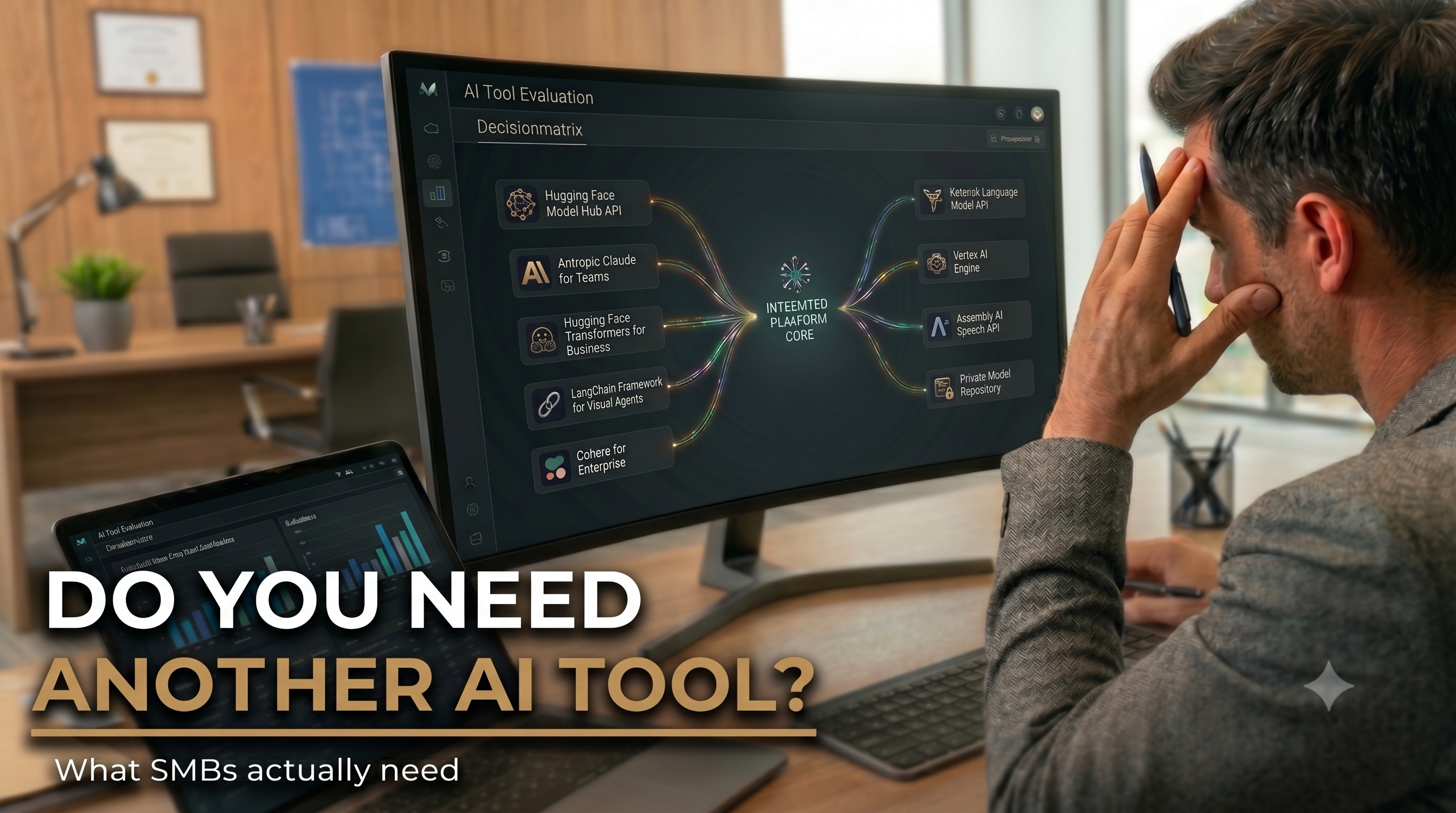
They Don't Want to Learn AI. They Want the Easy Button.

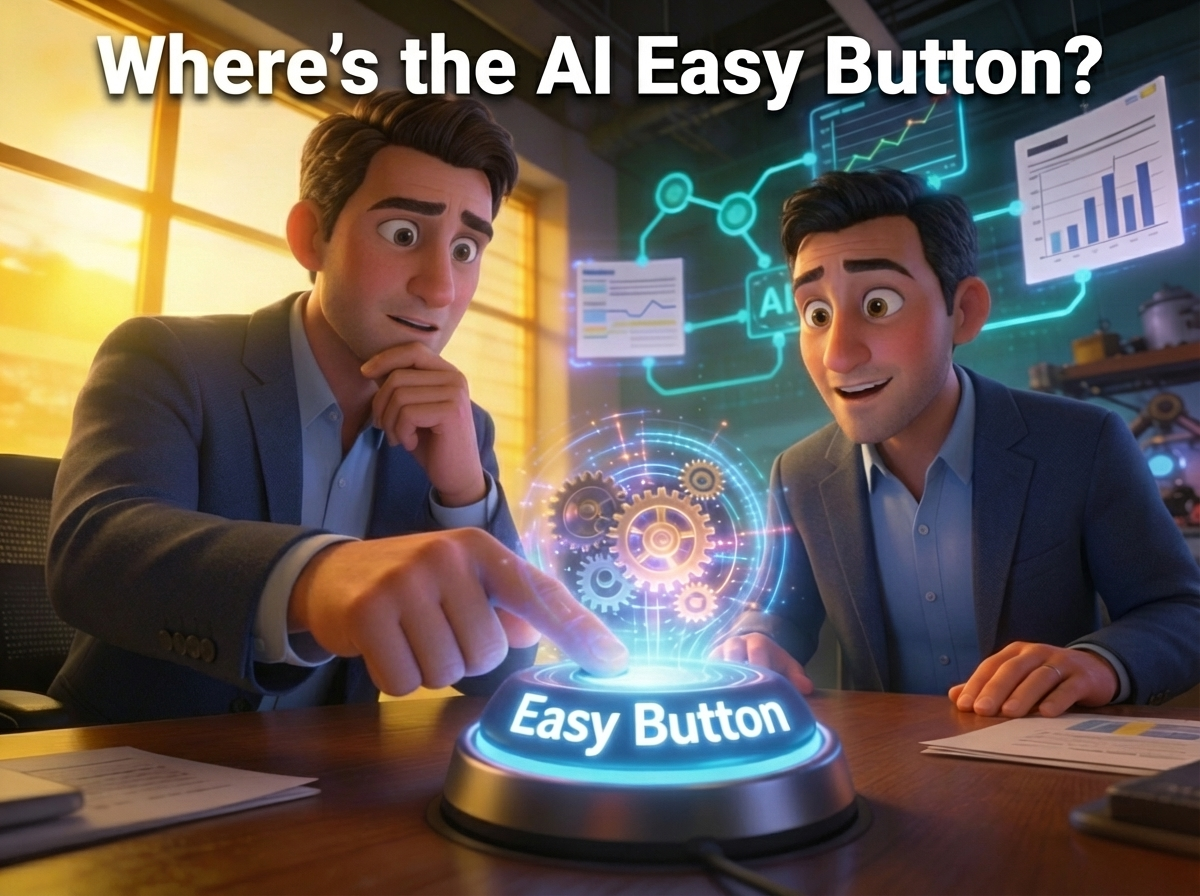
Where's the AI Easy Button?

We recently hosted an AI session for a group of business owners. We had slides. We planned for a 30-minute presentation and 30 minutes of Q&A.

They kept us for almost three hours.

Not because the slides were great. Because every question opened another question. The room included owners, investors, and executives from financial services, construction trades, property management, and protection services. Industries that have nothing in common except this: they all know AI matters, and none of them are sure what to do about it.


"I'm Not Creative Enough to Know What Problems to Bring to AI"

One exec said this out loud. Nobody laughed. Everyone nodded.

This was a successful, experienced leader being honest about a specific blind spot: he couldn't picture what AI does for his specific role. Not "AI can improve efficiency." He needed to know what it looks like on a Tuesday morning when he sits down at his desk. He couldn't even frame the right questions to ask.

These are leaders with vision -- that's how they built what they built. The gap is translating "AI matters" into a picture of what it actually does inside their business. And that gap is everywhere. Kellogg just published research naming this exact pattern. They call it Stage 1. Your people are using ChatGPT for the stuff they find annoying, but there's no strategy. No structure. Nobody connecting it to business outcomes. The tools exist. The vision doesn't.


"In Six Months, Will There Be a Product That Eliminates the Need to Do All This Learning?"

A different exec asked this one.

Another founder in the room took it further. He'd already decided to hire someone junior to start digging in. His real question was whether he could then hire us to train that person. He'd even framed the ROI on the spot -- $1,000 for a week to sit with his operations team and find the savings. He wasn't looking for a vendor. He was describing the model without knowing it had a name.

Two different people. Same request. Give me the easy button.

Here's the thing: that instinct is exactly right. The smartest thing a busy CEO can do is recognize what they're great at, running their business, and find someone to handle the rest. You don't build your own accounting software. You hire a CPA.

The problem isn't wanting the easy button. The problem is that most of the "easy buttons" on the market don't actually work.


Why the DIY Approach Stalls

The most advanced AI user in the room, someone who'd built a full property management operating system in seven days using AI, pushed back hard on the "hire someone" instinct.

His point: you can't hire a kid right out of college to figure this out for you. AI requires domain expertise. A junior hire doesn't know your business. They don't know which processes are bleeding money, which reports take six hours that should take six minutes, or which customer touchpoints are quietly falling apart.

Here's the number that tells the story: 56% of CEOs investing in AI still haven't seen revenue or cost benefits (PwC, January 2026). Not because the technology failed. Because the implementation did. They bought the tool without connecting it to a business problem. Or they handed it to someone who didn't understand the business well enough to know where to point it.

That's the pattern we see on almost every discovery call. Someone bought a tool, or assigned it to the most "tech-savvy" employee, and six months later the tool is gathering dust and the employee is back to doing things the old way. Not because anyone failed. Because the approach was wrong from the start.


What It Looks Like When It Works

Here's where the conversation turned. My CTO drew the distinction that stuck with everyone: the difference between an AI implementer and an AI champion. An implementer installs the tool and moves on. A champion is someone inside the business who changes how the team actually works. That's the role that matters -- and it's not a role you can hire off a job board.

The model that came out of the room was simple. Don't hire an AI person. Find someone already in your business who's curious, give them time and permission to experiment, and pair them with someone who actually knows the tools. Not an IT project. A business operations project. One founder put it simply: it's the same reason companies hire an MSP instead of building an internal IT team, or a fractional CFO instead of a full-time hire. You need the result. You don't want to manage the complexity.

That's the AI champion model. One person inside who knows the business. One partner outside who knows AI. The inside person spots the problems worth solving. The outside partner builds the solution and trains the team to use it.

We use this model ourselves. Our own AI systems handle daily briefings, prospect research before meetings, and coordination across our delivery team. Meeting prep that used to take 30 minutes now takes 5. We built them the same way -- started with the bottleneck, pointed AI at it, and trained ourselves to use it. We're our own first client.


The Easy Button Exists. It Just Doesn't Look Like Software.

That's not laziness. That's leadership. The CEO's job is to run the business, set the vision, and make the calls. Not to spend weekends watching YouTube tutorials about AI agents.

The easy button isn't a product you buy. It's a partner who already knows the tools, pairs with someone who knows your business, and builds systems your team can actually use. No more handing it to whoever seems most tech-savvy and hoping for the best. Just someone who's done this before, paired with someone inside who knows where the problems are.

If you're the person in that room nodding along, thinking "that's exactly what I want," that's what we built JOV AI to be.

If you want to talk through what this looks like for your business, reach out. I'll send you the three questions we use to find where AI saves the most time. Just a starting point.


Sources:

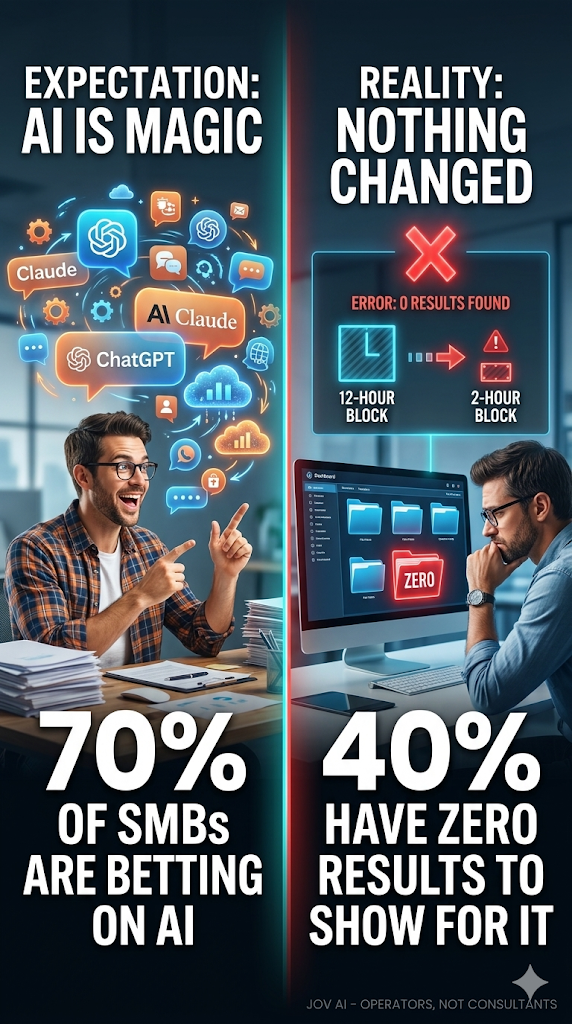
70% of Small Business Leaders Are Betting on AI. Here's What Successful AI Implementation Looks Like.

The Execution Gap

If you run a small business, you've probably had some version of this conversation in the last six months:

"We should be doing something with AI."

Maybe your office manager started using ChatGPT for emails. Maybe a competitor posted about their "AI-powered" workflow on LinkedIn. Maybe you sat through a vendor demo that promised to "transform your operations."

And then nothing happened. Or worse, something happened, but you can't point to what actually changed. Your AI implementation stalled before it started.

You're not alone. And your skepticism isn't a weakness. It's the right instinct.

The AI Implementation Optimism Is Real. The Results Aren't Yet.

The ECI AI Readiness Report came out this week. 550+ owners in manufacturing, field service, and distribution. These are the people in our world.

The headline: more than 70% of SMB leaders are positive about AI. That's not Silicon Valley hype. That's owners like you and me saying, "I think this thing can help my business."

But here's where it gets interesting. Despite that optimism, roughly 40% of those same businesses report zero measurable results from their AI efforts so far.

Seventy percent believe. Forty percent can't prove it's working.

That gap is the whole story.

And it's not just SMBs. Here's the kicker: PwC's latest CEO survey shows 56% of CEOs actively investing in AI haven't seen revenue or cost benefits yet. Only one in eight reported gains on both. If large companies with dedicated AI budgets are still struggling to show ROI, budget alone clearly isn't enough.

The will is there. The execution isn't.

What the Winners Are Actually Doing

So what separates the 60% getting results from the 40% who can't point to measurable ones?

It's not budget. It's not team size. It's not which tool they picked.

It's where they started.

The ECI report found that 60% of SMBs using or planning AI are focused on data analysis and reporting. Back-office work. Not chatbots. Not customer-facing AI. The boring stuff: pulling reports, reconciling data, tracking jobs.

That tracks with everything I've seen over the past two years. The wins don't come from flashy demos. They come from finding the one process that eats six hours a week and cutting it to thirty minutes.

Not "let's see what AI can do." Instead: "We spend 12 hours a week manually routing service calls. Can we cut that in half?"

That's the difference between experimenting and operating.

Why Most DIY AI Implementation Projects Stall

Here's a pattern I keep seeing. An owner gets excited about AI, assigns it to someone on their team, usually whoever seems most "tech-savvy," and says, "Figure out how we can use this."

Three months later, that person has tested a dozen tools, built a few clever prompts, and can't point to a single process that actually changed. Not because they're not smart. Because they're learning from scratch while still doing their real job.

Every time, the fix is the same. Stop leading with the technology. Start with the problem. That's what drives everything we do at JOV AI.

We run our business on the same AI systems we build for clients. It's the fastest way to find out what actually works, and the fastest way to kill what doesn't.

Why SMBs Have the Real Advantage

Here's what the big consultancies miss when they publish these reports: small businesses can move faster than anyone.

I wrote about this in The Blue-Collar AI Advantage. A 50-person HVAC company doesn't need a change management committee. The owner can decide on Tuesday, implement on Wednesday, and see results by Friday.

That speed is a structural advantage. Shorter decision chains. Closer to the actual work. Less bureaucracy between "this is a good idea" and "let's do it."

But it cuts both ways. When every dollar matters more, you can't afford to experiment blindly. A Fortune 500 company can burn a quarter-million on a failed AI pilot and write it off. You can't.

That's why the bottleneck-first approach matters even more for SMBs. You don't need an AI strategy. You need to fix one expensive problem and prove ROI before you touch anything else.

Stop Running AI Projects. Start Operating Your Business.

The companies getting results from AI aren't "doing AI." They're not running innovation labs or hiring prompt engineers.

They're doing what they've always done: finding inefficiencies and fixing them. AI just happens to be the tool that works right now.

The ECI report named the barriers holding most SMBs back, and none of them are surprising: no in-house expertise, messy data, and no idea where to start. Those aren't technology problems. They're AI implementation problems.

And that's exactly where the gap lives, between "AI can do amazing things" and "here's what it's doing for your P&L this quarter."

The testing phase is over. Seventy percent of your peers are ready to move. The question isn't whether AI works for small business. It's whether you'll be in the 60% getting results or the 40% still unable to point to what changed.

Start Here

What's your most expensive bottleneck this week? The process that eats the most hours, causes the most errors, or keeps you from focusing on growth?

Start there. Not with a chatbot. Not with a strategy deck. With one problem, one measurement, and one fix.

That's how the winners are doing it.

If you want to talk through where AI implementation fits in your operations, not a sales pitch, just a straight conversation about your bottleneck, reach out. We'll tell you if AI isn't the answer. And if it is, we'll show you exactly where to start.

The Blue-Collar AI Advantage Nobody's Talking About

The Blue-Collar AI Advantage

Your best tech is losing two to three hours a day to bad routing. Your estimator is rebuilding the same spreadsheet for the third time this week. Your office manager is chasing invoices instead of chasing growth.

None of that is a technology problem. It's operational drag. And it's capping how fast your business can grow.

Most trades owners assume AI isn't for them yet. That's exactly why the ones adopting it now are pulling ahead so fast. HVAC. Plumbing. Construction. Manufacturing. Field services. Where almost no one has started, even basic AI puts you a generation ahead.

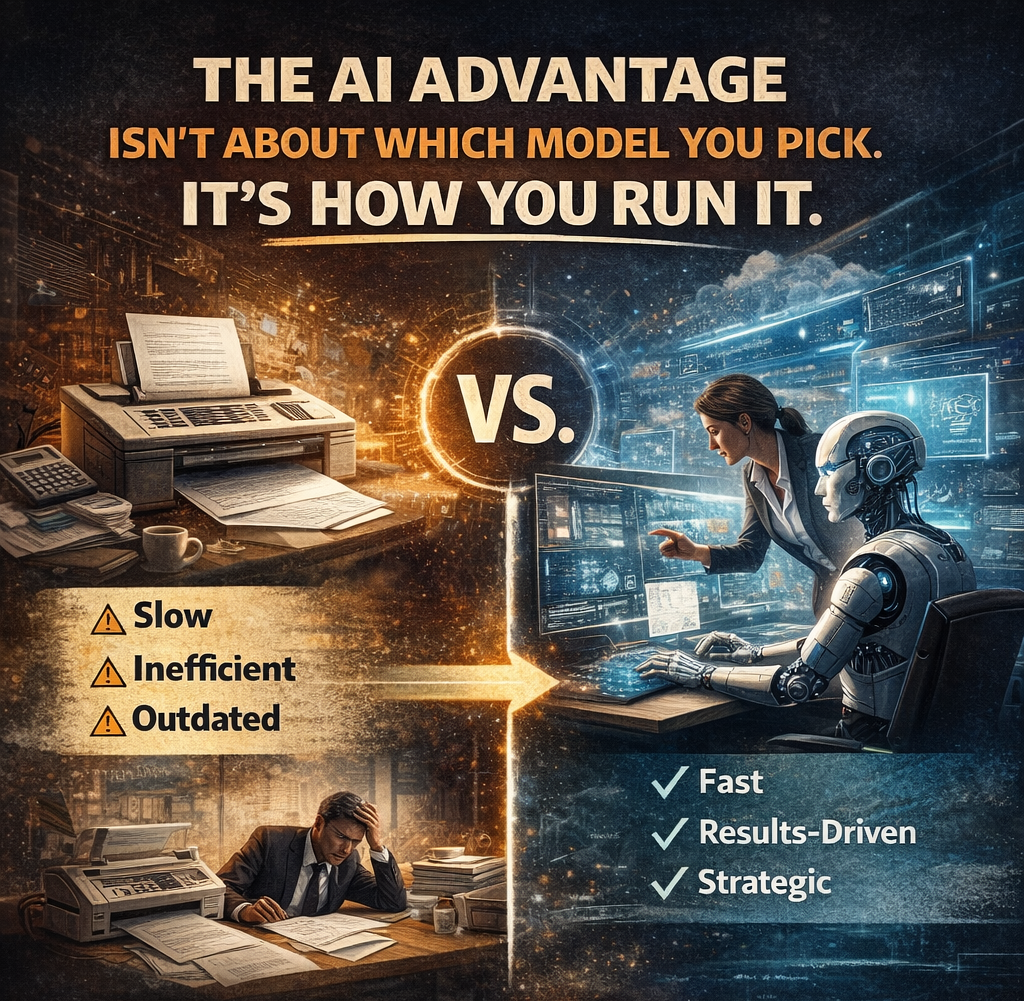
The AI Advantage Isn't About Which Model You Pick. It's How You Run It.

Every few months, a new AI model drops and the internet loses its mind. GPT-5-whatever. Gemini-some-number. The next thing.

It's like the iPhone when they were new—each number was a big deal. I used to get excited too. But can you honestly tell me the kid fresh out of college is getting more ROI out of a new iPhone than the business operator on one that's three years old?

Now, look at the guy who doesn't have a cell phone and is still faxing documents—how's he doing?

That's what I mean. Debating which AI model to use is like worrying about which carrier to get cell service through. Meanwhile, most business owners haven't figured out what to do with the last model.

Here's what's easy to miss in the noise: the models got good. Really good. Three years ago, AI couldn't write a decent email. Now it can draft proposals, analyze contracts, and handle first-line customer support. Small and medium-sized businesses have access to the same capabilities enterprise companies are spending millions to deploy.

So why are some businesses pulling ahead while others spin their wheels?

It's not which AI they picked. It's how they run it.

The AI Advantage

What Are You Waiting For?

82% of enterprise decision-makers now use AI weekly. 46% use it daily. These aren't employees experimenting on the side—these are the people running things. VPs, C-suite, the ones setting strategy and making decisions. (Wharton, 2025)

Meanwhile, only about 9% of small businesses have adopted AI. (SBA, 2025) That's SBA's cut of Census data on firms reporting active AI use, not just experimentation.

That's the gap. The models are the same. You have access to the same AI enterprise leaders are using daily.

4 Years in AI: Trial by Fire

4 Years in AI

In 2022, I walked away from a 15-year career in bond trading to build AI models. I thought I knew exactly how this would play out.

I was right about the opportunity. I was wrong about the timeline.

That gap between promise and payoff is the real story, and it's the reason most small businesses still haven't figured out how to make AI work for them.